


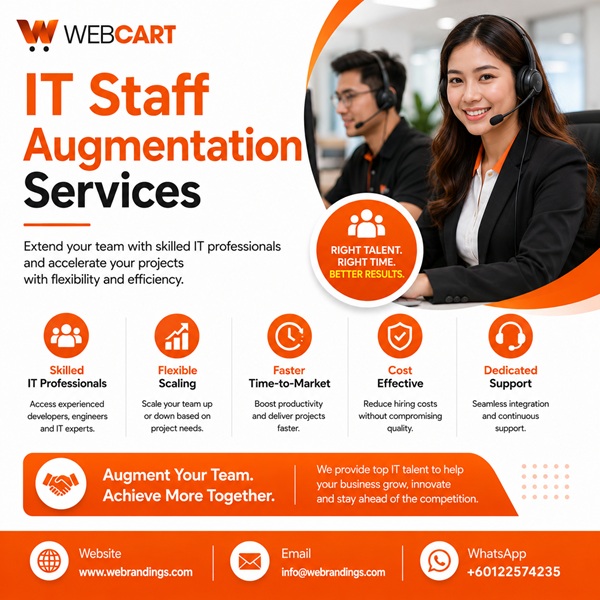
When IT Staff Augmentation Services Make Sense
Hiring usually looks slower and more expensive once the real work starts. A project timeline slips, internal developers are stretched thin, and suddenly the issue is not strategy – it is capacity. That is where it staff augmentation services can make a practical difference. Instead of starting a full recruitment cycle for every technical gap, businesses can add the right specialists when they need them and keep delivery moving.
For many small and mid-sized companies, this is not just a staffing decision. It is an operational decision that affects deadlines, budgets, product quality, and customer experience. If your website, ecommerce platform, mobile app, or internal system depends on timely technical execution, waiting months to hire full-time talent is often the costlier option.
What IT staff augmentation services actually mean
IT staff augmentation services allow a business to extend its existing team with outside technical professionals. These specialists work alongside your internal staff and support active projects, ongoing maintenance, or short-term workload spikes. The model is flexible by design. You may need one frontend developer for a redesign, two QA engineers for a product launch, or a broader technical team to stabilize operations after rapid growth.
This is different from traditional outsourcing in one important way. With augmentation, your business usually keeps more direct oversight over tasks, priorities, and delivery standards. The augmented team becomes an extension of your operation rather than a separate vendor working in isolation.
That distinction matters. Some companies want full project outsourcing because they do not have internal technical leadership. Others already have a manager, CTO, or operations lead in place and simply need capable people to execute. In those cases, augmentation often fits better.
Why businesses choose IT staff augmentation services
The biggest reason is speed. Recruiting full-time IT talent is competitive, time-consuming, and uncertain. Even after interviews and offers, onboarding takes time before a new hire becomes productive. If your business has a product release, ecommerce upgrade, migration, or backlog of technical fixes, that delay can affect revenue and customer trust.
Cost is another factor, but it should be viewed carefully. Staff augmentation is not always cheaper on a line-by-line hourly comparison. A senior specialist may cost more per hour than an employee salary equivalent. The advantage comes from avoiding long hiring cycles, benefit overhead, retention risk, and underutilized staff after a project ends.
There is also the matter of expertise. Many businesses do not need a full-time specialist in every area year-round. You might need a Shopify or Magento developer for one phase, a DevOps engineer during infrastructure setup, or multilingual support staff during business expansion. Hiring permanent staff for narrow or temporary needs rarely makes sense.
When staff augmentation is the right choice
The model works well when your internal team is capable but overloaded. Maybe your developers are handling daily support tickets while a major website rebuild is waiting. Maybe your ecommerce store is growing faster than expected and your current team cannot keep up with integrations, updates, and performance fixes.
It also works when a project requires skills your in-house team does not have. A mobile app build, API integration, cloud migration, or security review may require experience that would take too long to develop internally. Augmentation lets you add that expertise without pausing business momentum.
Another common scenario is business uncertainty. If you are testing a new digital product, entering a new market, or scaling after a successful sales period, committing to permanent headcount may feel premature. Augmented staff gives you room to move without locking in fixed long-term cost too early.
Where companies get it wrong
Staff augmentation is useful, but it is not magic. The model breaks down when businesses assume extra people alone will solve unclear processes or weak leadership. If priorities are constantly changing, requirements are undocumented, or no one owns delivery, even skilled external talent will struggle.
Another mistake is choosing based on price alone. Low rates can look attractive until communication slows down, work quality drops, or turnover forces repeated retraining. The cheaper option often becomes expensive when bugs pile up or launch dates move.
There is also a cultural fit issue that many decision-makers underestimate. Augmented staff still need to collaborate with your team, understand your pace, and communicate in a way that supports the business. Technical ability matters, but reliability, responsiveness, and accountability matter just as much.
How to evaluate IT staff augmentation services
Start with the business problem, not the resume checklist. Are you trying to speed up delivery, fill a temporary skill gap, support an overloaded internal team, or reduce hiring risk? The right provider should understand that context before suggesting roles.
Next, look at the provider’s range of capabilities. A strong partner can usually support more than one isolated task. That matters because business needs change. A company that can assist with development, support, infrastructure, ecommerce, QA, and digital operations gives you continuity when priorities shift.
Communication should be tested early. Ask how work is managed, how updates are shared, who handles escalation, and what happens if a resource is not the right fit. A dependable provider should answer these questions directly and without vague promises.
You should also pay attention to onboarding. Good it staff augmentation services do not just assign a developer and disappear. They create a structure for handoff, access, documentation, reporting, and performance alignment. That early setup often decides whether the engagement becomes efficient or frustrating.
The trade-offs to consider
There is no single staffing model that works for every company. Full-time hiring gives you deeper long-term internal knowledge and stronger team continuity. Outsourcing entire projects can reduce management burden. Staff augmentation sits between those options.
That middle ground is often valuable, but it comes with a requirement: your business needs enough internal direction to guide the work. If no one can prioritize tasks or review output, a fully managed solution may be better. On the other hand, if you already have clear goals and need execution support, augmentation can be the most efficient path.
Security and access are another valid concern. External staff may need access to systems, codebases, customer data, or hosting environments. This does not make augmentation risky by default, but it does mean the provider should have clear controls, confidentiality practices, and a professional operating model.
What a good partner looks like
A good augmentation partner does more than fill seats. They help you think through what kind of support actually fits the work. Sometimes that means recommending one senior engineer instead of three junior resources. Sometimes it means combining technical support with website maintenance or ecommerce operations because the business problem crosses departments.
This is where a consultative provider stands out. Businesses often come in asking for a developer when what they really need is a blended solution that includes development, support, hosting coordination, or performance troubleshooting. The right partner helps define the gap clearly so you do not overhire or hire the wrong role.
For companies that want a dependable long-term relationship rather than a rotating list of freelancers, service continuity matters. The provider should be responsive, transparent, and invested in the business outcome, not just the timesheet.
A smarter way to scale technical capacity
For growing businesses, technical demand rarely arrives in a neat, predictable pattern. A quiet quarter can be followed by a site relaunch, a marketing push, a spike in online sales, or a platform issue that needs immediate attention. Building a full in-house team for every possibility is rarely practical.
That is why staff augmentation remains a strong option for companies that need flexibility without giving up control. It can support growth, reduce pressure on internal teams, and keep digital projects moving without the long delay of traditional hiring. When managed well, it becomes less about temporary staffing and more about giving your business access to dependable technical capacity at the right time.
If you are weighing your next hire against your next deadline, that is usually the moment to step back and ask a better question: do you need another employee, or do you need the right support structure to keep your business moving forward?
