


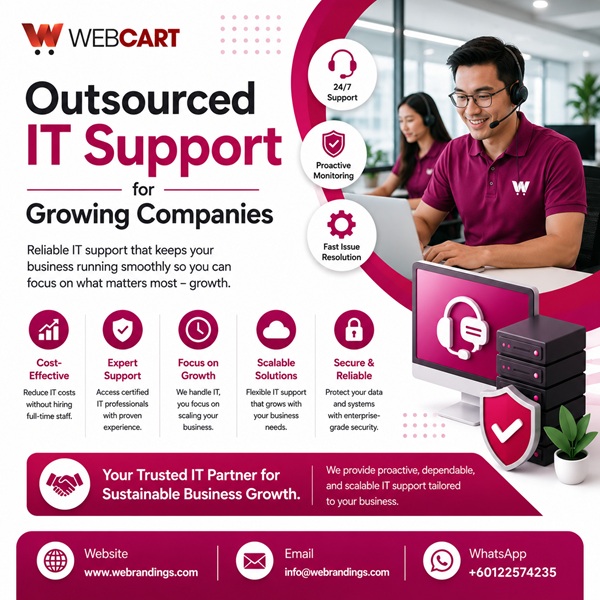
Outsourced IT Support for Growing Companies
Growth usually exposes IT problems before it rewards the business. A company adds staff, launches new locations, expands ecommerce, or increases online marketing, and suddenly systems that once felt manageable start causing delays. That is why outsourced IT support for growing companies has become a practical move for businesses that need stability without the cost and complexity of building a full internal team too early.
For many small and mid-sized businesses, the issue is not whether IT matters. It is whether the business can get dependable support fast enough, with the right level of expertise, and at a cost that still makes sense. Growth creates pressure on websites, hosting, internal tools, user access, cybersecurity, customer support systems, and operational workflows. When support is fragmented across freelancers, one in-house generalist, and multiple vendors, problems tend to pile up at the worst possible time.
Why outsourced IT support for growing companies makes sense
A growing company rarely needs just one kind of technical help. It may need website support, hosting management, email troubleshooting, user onboarding, ecommerce maintenance, security updates, backup monitoring, and advice on what to fix first. Hiring separate specialists for each area is expensive and difficult to coordinate. Hiring a full in-house team is even more expensive.
Outsourced support gives growing businesses access to broader capability without carrying the full cost of multiple salaries, benefits, training, and management overhead. That matters most when the company is still making careful decisions about where to invest. Every dollar committed to permanent headcount has to compete with marketing, sales, inventory, operations, and product development.
There is also a speed advantage. An experienced outsourced partner has usually seen the same patterns before. Slow sites after traffic spikes, plugin conflicts, user permission issues, hosting misconfigurations, poor backup routines, and basic security gaps are not unusual problems. They are recurring business issues that need structured handling, not panic.
That said, outsourcing is not automatically the right answer in every situation. If a business has highly specialized infrastructure, strict internal compliance requirements, or a large enough technical environment to justify full-time specialists across several disciplines, in-house leadership may still need to anchor the function. For many growing businesses, though, outsourced support works best as either the main IT function or an extension of a lean internal team.
The real pressure points during growth
Most companies do not start looking for outside support because of one dramatic failure. More often, they reach a point where small issues are happening too often. Staff cannot access the tools they need. The ecommerce site slows down during promotions. Website changes take too long. Nobody is fully sure who owns backups, updates, or monitoring. Support requests arrive through scattered emails, messages, and phone calls with no clear priority system.
These issues affect more than convenience. They affect revenue, customer trust, and internal productivity. If your website goes down during a campaign, if checkout errors appear on a store, or if your staff loses hours to recurring system issues, the business is paying for weak support whether it shows up as an IT expense or not.
Growing companies also need better planning, not just better repair work. A support model that only reacts after something breaks may keep operations moving for a while, but it does not prepare the business for scale. As transaction volume rises and teams get larger, systems need more structure. That includes documented processes, proactive maintenance, clearer ownership, and practical advice on what to standardize.
What good outsourced IT support should actually include
Not all providers deliver the same kind of value. Some are ticket closers. Others work more like long-term partners. For a growing company, that distinction matters.
Good outsourced support should cover daily operational needs while also helping the business make better technical decisions. That means responsive issue resolution, but it should also include preventative maintenance, monitoring, updates, and guidance tied to business goals. If the company relies on its website or ecommerce platform for lead generation or sales, support should not stop at the server. It should consider how technical performance affects conversion, customer experience, and business continuity.
The strongest providers also understand that non-technical leaders need clear communication. Business owners and operations managers do not want jargon-heavy explanations. They want to know what the issue is, what is being done about it, how urgent it is, and whether it is likely to happen again.
This is especially valuable when a company wants one dependable partner instead of a patchwork of vendors. In practice, businesses often benefit most from support teams that can handle website infrastructure, ecommerce maintenance, hosting, performance issues, security basics, and user support in a coordinated way. That reduces handoff delays and removes the familiar problem of vendors blaming one another.
Cost control matters, but so does risk control
One reason businesses consider outsourcing is predictable cost. Compared with hiring internally, outsourced support often lowers upfront expense and makes budgeting easier. You can align service levels with current needs rather than committing to a full internal department before the workload truly requires it.
But focusing only on the monthly fee can lead to the wrong choice. The cheaper provider is not always the lower-cost option if response times are poor, communication is weak, or expertise is too limited. A support partner that misses issues affecting uptime, security, or site performance can become expensive very quickly.
A better way to evaluate cost is to compare it with the business risk being reduced. How much would one day of website downtime cost? What is the impact of delayed order processing? How much management time is spent chasing technical fixes instead of moving the business forward? Reliable support should reduce those hidden costs, not just offer a lower invoice.
When to move from ad hoc help to a real support partner
Many businesses wait too long. They rely on a developer who helps occasionally, a hosting provider that only manages part of the environment, or an internal staff member who covers IT on top of other responsibilities. That can work in the early stages, but growth tends to expose the limits.
If your team is constantly following up on unresolved issues, if website or ecommerce changes are backing up, if support knowledge lives in one person’s head, or if your business has no clear maintenance routine, it is usually time to move to a more structured setup.
Another clear sign is when technical decisions begin affecting growth strategy. If launching new products, entering new markets, or scaling campaigns depends on whether your systems can handle the demand, support is no longer a background function. It is part of how the business grows.
In those situations, an outsourced partner should not just fix what breaks. The partner should help organize the environment, reduce recurring friction, and create a support model that can keep pace with expansion.
How to choose outsourced IT support for growing companies
Start with fit, not just features. A provider may be technically capable but still be the wrong match if it cannot support your pace, your business model, or the systems you rely on most.
Look for a team that understands the commercial side of IT support. If your website, online store, booking platform, or digital operations are central to revenue, your provider should treat those systems as business-critical. Ask how they handle urgent issues, what they monitor proactively, and how they communicate priorities.
It also helps to choose a partner with service breadth. Growing companies often need more than one isolated fix. They may need web support, hosting, technical consultancy, user assistance, and development coordination under one relationship. A company like WEBRANDINGS (M) SDN BHD can be valuable in that setting because businesses often benefit from having a partner that understands both the technical systems and the digital channels driving growth.
Just as important, ask about process. How are requests submitted? Who owns follow-up? What happens after hours? How are recurring issues identified and reduced over time? Good support is not just responsive. It is organized.
The best support model grows with the business
A business that is adding staff, customers, products, or digital channels needs more than a help desk. It needs support that can adapt as operations become more complex. That may start with day-to-day troubleshooting and maintenance, then evolve into infrastructure planning, ecommerce optimization, security improvements, or staff augmentation.
The right outsourced model gives you room to grow without forcing early over investment. It also gives leadership more confidence. When technical support is dependable, management can focus on sales, operations, and customer experience instead of chasing unresolved issues.
There is no single formula that fits every company. Some need a fully outsourced setup. Others need a hybrid model with internal oversight and external execution. What matters is choosing support that matches your current stage while being capable of supporting the next one.
Growth is hard enough without unreliable systems slowing it down. If your business is reaching the point where technical issues are affecting momentum, the best next step is often not hiring fast. It is choosing a partner that can solve problems consistently, communicate clearly, and help your business scale with fewer surprises.
